
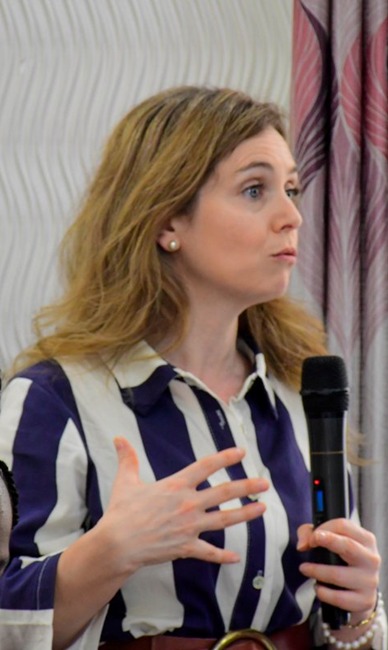
Global Alliance on Health and Pollution (GAPH) Executive Director Maria Paola Lia
Global experts meet in Kenya to combat pollution
Nairobi, June 17, 2026 – Environmental experts, policymakers, civil society representatives and international organizations have convened in Nairobi for the Sub-Saharan Africa Regional Pollution Forum 2026, seeking practical solutions to one of the region’s most pressing public health and environmental challenges.
The multi-day summit, hosted by the Global Alliance on Health and Pollution (GAHP), opened on Tuesday and brought together delegates from eight African countries to discuss strategies for tackling toxic waste, air and water pollution, hazardous chemicals and emerging environmental threats.
Organizers noted that pollution is responsible for an estimated nine million premature deaths globally every year, while air pollution alone causes more than 20,000 deaths annually in Kenya.
The forum focuses on strengthening regional responses to industrial and vehicular emissions, addressing the growing threat posed by hazardous chemicals and microplastics, and bridging the gap between scientific evidence and policy implementation.
Speaking during the opening session, GAHP Executive Director Maria Paola Lia said pollution cannot be effectively addressed by individual countries acting in isolation because environmental threats transcend national borders.
“Pollution is something that a country or an organization cannot deal with alone. It requires cross-sectoral collaboration and cooperation at national, regional and community levels,” she said.
Ms Lia cited Lake Victoria as an example of a shared resource whose pollution affects multiple countries regardless of where contamination originates.
“When we talk about contamination of Lake Victoria and poor water quality in Uganda, the problem does not stop in Uganda. We share borders and resources, and unless countries address pollution collectively, we will not stop the problem,” she said.
She said GAHP’s role is to convene governments, experts and communities to build awareness, strengthen political commitment and enhance capacity for addressing pollution-related health risks.
According to Ms Lia, the forum seeks to promote locally developed solutions that are affordable, practical and scalable across Africa.
“We wanted the forum in Africa to be done with Africans and by Africans so that the solutions discussed are locally implementable and achievable. We often focus on the problems and forget that solutions already exist,” she said.
Participants shared experiences on waste management, open burning, water contamination and other common environmental challenges affecting countries across the region.
The forum also highlighted successful interventions that can be replicated elsewhere, including the use of digital technologies, community-led approaches and circular economy models aimed at reducing waste while creating economic opportunities.
Among the key recommendations emerging from working group discussions were the need to connect scientific evidence to action, balance incentives with regulatory measures, and increase investment in innovative pollution-control solutions.

Dr. Paul Saoke, Africa Regional Director, GAHP and Vice-Chair of the United Nations Environmental Programme Global Alliance on non-chemical control of malaria
Dr. Paul Saoke, Africa Regional Director, GAHP and Vice-Chair of the United Nations Environmental Programme Global Alliance on non-chemical control of malaria said the gathering offers a platform for countries facing similar environmental challenges to learn from one another and coordinate responses.
“Pollution does not stop at borders. Countries across the region are dealing with similar issues related to waste management, water pollution and air quality. Through collaboration and knowledge sharing, we can identify solutions that can be scaled up across the region,” said Dr Saoke.
He noted that regional cooperation is critical because environmental degradation and its health consequences affect communities across national boundaries.
Ms Lia highlighted Uganda as an example of how small initiatives can evolve into impactful national programmes through collaboration among governments, environmental agencies and development partners.
She recalled that GAHP initially launched a modest $10,000 lead-awareness project in Uganda before expanding the initiative through partnerships with the Ugandan government, the National Environment Management Authority and the Ministry of Health.
The collaboration later resulted in the development of a Health and Pollution Action Plan, demonstrating how targeted investments and local commitment can generate meaningful environmental outcomes.
However, Ms Lia expressed concern over shrinking international development budgets, noting that some traditional donor countries are redirecting resources towards defence spending, making it more difficult to secure funding for environmental health programmes.
Despite these challenges, she said GAHP remains committed to supporting African countries in identifying resources and building partnerships needed to address pollution.
The Nairobi forum is expected to conclude with recommendations aimed at strengthening regional cooperation, accelerating policy implementation and scaling up successful interventions to reduce pollution-related health risks across Sub-Saharan Africa.
The Regional Pollution Forum is being implemented through a partnership between GAHP and regional stakeholders, with funding support from UK International Development through the United Kingdom’s Department for Environment, Food and Rural Affairs (Defra).
More Stories
Xinjiang’s cotton fields nurturing new generation of tech-savvy farmers
Xictionary: Healthy China
United Kingdom (UK) Speaker of House of Commons to attend 153rd Inter-Parliamentary Union Assembly in Tanzania