
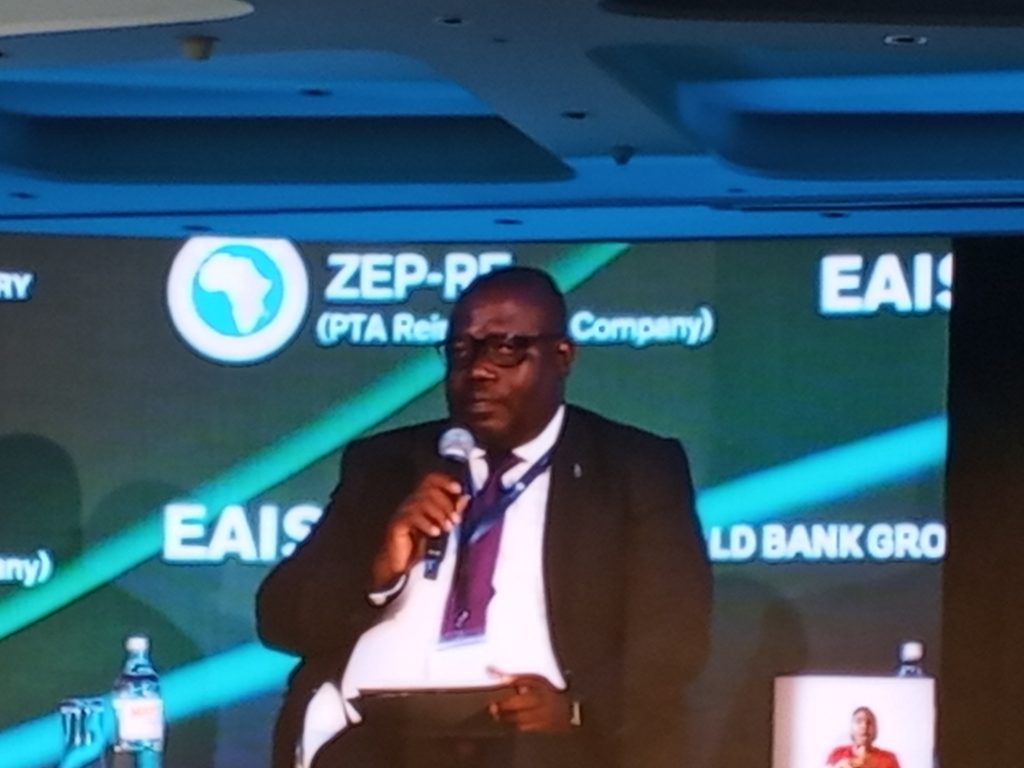
Likezo Musobani, Acting Director – Disaster Risk Management, Disaster Risk Management Division in Zambia
Zambia is accelerating the adoption of proactive disaster risk financing instruments to safeguard critical economic sectors and vulnerable communities against recurring climate shocks, a senior official said here Monday.
Speaking at the high-level Climate and Disaster Risk Financing and Insurance (CDRFI) Africa Forum in Nairobi, Likezo Musobani, Acting Director – Disaster Risk Management, Disaster Risk Management Division in Zambia, outlined the southern African nation’s enhanced financial preparedness strategies following severe historical droughts.
”Drought for Zambia is a shock of economic importance,” Musobani said, noting that the 2023–2024 rainy season exposed critical vulnerabilities in sectors such as agriculture and hydroelectric power, which forms the core of the national economy.
To mitigate future shocks, the Zambian government has undertaken major structural shifts, including diversifying its energy mix away from an 80 percent reliance on hydropower toward a combination of solar, coal, and hydro energy to build redundancy and resilience.
Alongside energy diversification, Zambia is scaling up financial response tools and pre-arranged disaster risk instruments to protect public finances and vulnerable populations.
Key measures highlighted by Musabani include:
- Budgetary Contingency Expansion: Increasing the national budget’s contingency line allocation to 5 percent of the total annual budget to serve as a primary emergency response mechanism.
- Catastrophe Deferred Drawdown Option (Cat DDO): Partnering with the World Bank to sign a Cat DDO facility to secure immediate liquidity when natural disasters occur.
- Sovereign Risk Insurance: Maintaining sovereign drought insurance with the African Risk Capacity (ARC) since 2021.
- Regional Recovery Programs: Signing onto the Regional Emergency Preparedness and Access to Inclusive Recovery and Repair Program (REPAIR) and adopting Contingency Emergency Response Components (CERC) with World Bank support.
Zambia’s commitment to sovereign insurance has delivered concrete financial payouts, securing 5.3 million U.S. dollars during an earlier drought payout and 9.9 million dollars following the most recent drought, alongside 3.3 million dollars received by the World Food Programme as a replica partner.
Demonstrating strong domestic ownership, Zambia has increased its premium payment commitment to the ARC program from 100,000 U.S. dollars in 2021 to 1 million dollars in the last season.
Following a diagnostic study conducted with the World Bank, Zambia is currently developing a comprehensive national disaster risk financing strategy with technical support from the World Bank, the African Development Bank, and the United Nations Development Programme
More Stories
Xinhua Headlines: Why global travelers flock to China with empty suitcases
Faith Mwaura: From tree planting to climate finance, a green agenda takes shape in Roysambu
Photo exhibition highlights China-Rwanda friendship, cooperation