
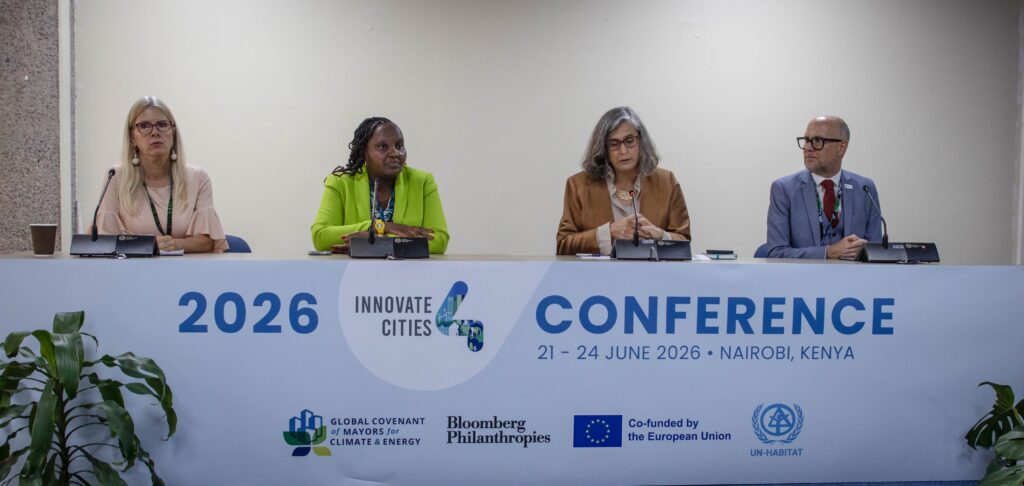
Anaclaudia Rossbach Executive Director of the United Nations Human Settlements Programme (UN-Habitat)
Diana Urge-Varsatz, Vice chair Intergovernmental Panel on Climate Change (IPCC), the United Nations agency on climate change
Innovate4Cities Conference kicks off in Kenya with calls for science-based solutions to address growing climate and development challenges facing cities worldwide
NAIROBI, Kenya, June 22, 2026 — Global leaders, scientists, mayors and urban development experts gathering in Nairobi for the opening of the Innovate4Cities Conference called for stronger partnerships, science-based solutions and coordinated governance to
address the growing climate and development challenges facing cities worldwide.
The three-day conference, hosted at the United Nations headquarters in Nairobi, opened with a clear message: cities are at the centre of both the climate crisis and its solutions.
Opening the conference, Anna Claudia, speaking on behalf of UN-Habitat, highlighted the urgency of addressing rapid urbanisation, particularly in Africa.
“Africa is urbanising fast,” she said, noting that nearly half of humanity still lacks access to adequate housing while hundreds of millions continue to live in informal settlements.
She emphasized that cities must be placed at the center of the global development agenda and said the outcomes of the conference would contribute to discussions leading to COP31 and the review of the New Urban Agenda at the United Nations in New York next month.
Claudia stressed the importance of science-driven decision-making, citing the role of the Intergovernmental Panel on Climate Change (IPCC) and UN-Habitat’s commitment to evidence-based solutions for housing, urban resilience and sustainable development.
Andy Deacon, Co-Managing Director of the Global Covenant of Mayors, reflected on the organization’s ten-year journey as the world’s largest alliance of cities committed to climate action.
Formed a decade ago, the network now includes more than 14,000 cities worldwide, with Nairobi among its early members.
“Cities are implementing climate action,” Deacon said, adding that urban centers hold enormous potential to reduce global emissions and accelerate the transition toward a low-carbon future.
He noted that effective climate action requires co-creation among governments, researchers, businesses and communities.
Teresa, another keynote speaker, called for people-centered solutions amid increasing global tensions linked to energy, food and water insecurity.
“We need stronger partnerships and a stronger sense of ownership,” she said. “Innovate4Cities is about sharing knowledge and accelerating our collective response.”
The Executive Director of the United Nations Environment Programme, Inger Andersen, warned that climate change, pollution and biodiversity loss are creating compounding risks that disproportionately affect vulnerable communities.
“Every fraction of a degree matters,” she said, warning that the world is on course to exceed the 1.5°C warming threshold.
Andersen urged city leaders to embrace data-driven governance, invest in climate adaptation and resilience, and strengthen public-private partnerships capable of transforming ambition into implementation.
“Cities that tackle pollution and environmental challenges effectively will attract investment and create prosperity,” she said.
Vice Chair of the IPCC, Professor Diana Ürge-Vorsatz, underscored the importance of science in guiding urban climate action.
She noted that Europe is already experiencing record temperatures and emphasized that the forthcoming IPCC Special Report on Cities would provide critical evidence for policymakers and practitioners seeking to accelerate climate action.
“The report should speak loudly,” she said. “Everyone should take action.”
Representing Nairobi City County, County Executive Committee Member for Green Nairobi, Maureen Njeri, highlighted Nairobi’s efforts to position itself as a city of innovation and sustainability.
She pointed to the establishment of an Air Quality Working Group that brings together multiple stakeholders to support scientific research, innovation and enforcement efforts aimed at improving urban air quality.
Governance and Partnerships in Focus
A high-level panel discussion on multi-level governance and partnerships explored how different levels of government, research institutions and development partners can work together to address climate challenges.
Maureen Njeri emphasized the importance of clear policies, reliable data and climate action plans that move beyond commitments to implementation.
Kisumu Governor Peter Anyang’ Nyong’o argued that effective coordination between local and national governments is essential, especially in responding to disasters such as flooding.
“Floods affect everyone,” he said, calling for stronger institutional mechanisms to coordinate climate action.
Nyong’o highlighted Kisumu’s collaboration with partners on solar energy initiatives, air quality monitoring and climate planning, stressing the need for improved access to climate finance.
IPCC Working Group Co-Chair Winston Chow noted that fragmented governance remains one of the biggest barriers to climate action.
He argued that climate policies can simultaneously address poverty, housing and urban resilience when implemented through coordinated partnerships.
“Local communities know where the risks lie,” Chow said, emphasizing the need to integrate scientific research with community knowledge.
Engineer Byron Buyu pointed to inadequate financing as a major challenge facing urban centers, while Rose Bailey stressed the importance of coherence across government departments and institutions.
“We cannot work in isolation,” she said. “Everybody must sing from the same script.”
Bailey highlighted the importance of robust and aligned data systems, warning that institutional turnover often leads to a loss of knowledge and weakens long-term climate planning.
Throughout the opening day, a common theme emerged: the future of climate action will depend not only on technology and finance, but on collaboration, coordination and partnerships that bring together governments, scientists, businesses and communities.
As delegates continue discussions over the next three days, the conference aims to generate practical solutions capable of transforming cities into engines of climate resilience, innovation and sustainable development.
For many participants, the cost of inaction is becoming increasingly clear — and the success of future climate action will ultimately be measured by how effectively cities work together to build a more sustainable future.
More Stories
Xinjiang’s cotton fields nurturing new generation of tech-savvy farmers
Xictionary: Healthy China
United Kingdom (UK) Speaker of House of Commons to attend 153rd Inter-Parliamentary Union Assembly in Tanzania