
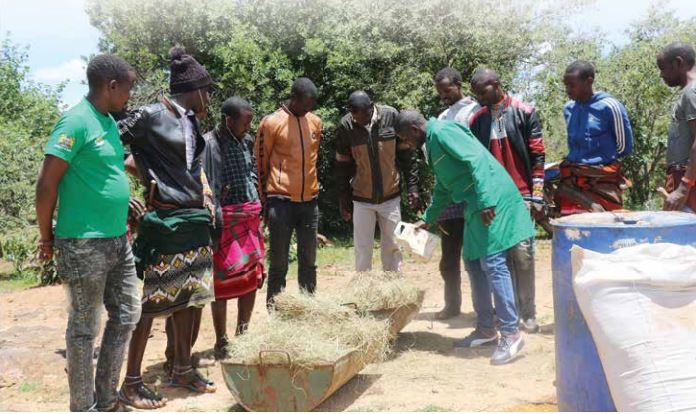
From Training to Trade: How Northern Rangelands Trust Is Turning Skills into Second Chances Along Kenya’s Coast
At sunrise in a small coastal settlement near Lamu, the day used to begin with a decision that was never really a choice.
Go to the ocean—or go without.
For many young people here, that was the reality. Fishing was not just a livelihood; it was the default. Even for those who had never wanted it, the path was already laid out. The sea offered opportunity, but it also carried risk—unpredictable catches, dangerous waters, and an income that could vanish overnight.
For Abdalla, that life almost became permanent.
He left school early, like many others, and spent his late teens following older fishermen out to sea. Some days were good. Most were not. What he remembers most, he says, is the waiting—waiting for the nets, waiting for buyers, waiting to see if the day would end with anything to take home.
“It felt like we were always chasing something that kept moving,” he says. “You work the whole day, and sometimes you still come back with nothing.”
It was during one of those seasons—when the catch had been consistently low—that Abdalla heard about a training opportunity under a programme supported by the Northern Rangelands Trust (NRT): Ujuzi Manyattani.
At first, he didn’t take it seriously.
Training meant time away from the ocean. It meant uncertainty. And like many others, he wondered what skills could really offer in a place where opportunity had always seemed limited.
But he signed up.
Months later, he was no longer heading out to sea.
Instead, he was learning electrical installation—wiring, repairs, small systems that power homes and businesses. The transition was not immediate, and it was not easy. When the training ended, the biggest challenge remained: turning knowledge into income.
“I had the skills,” he recalls, “but I had no tools, no customers. That part was harder than the training.”
A basic toolkit cost more than he could afford—roughly KES 15,000 to 20,000 (about USD 100–130). For someone used to earning day-to-day, it was a significant barrier.
He borrowed where he could. Started small. Took on minor repair jobs. Sometimes worked for free just to prove he could do it.
Slowly, the work came.
Today, Abdalla earns a steady income—installing wiring in homes, repairing electrical faults, and taking on small projects across his community. It is not a dramatic transformation, but it is a stable one.
And that stability is what matters.
Across coastal Kenya, stories like Abdalla’s are becoming more common.
Through Ujuzi Manyattani, young people are gaining skills in trades that extend beyond traditional livelihoods—tailoring, carpentry, mechanics, solar installation. These are practical, market-oriented skills designed to create alternatives in environments where options have historically been limited.
The outcomes are already visible.
More than 70% of participants are now self-employed or engaged in income-generating activities, a significant shift in regions where unemployment and underemployment have long shaped economic reality.
But the impact goes beyond employment.
It changes how households function.
It changes how communities interact with their environment.
And it changes what young people expect from their future.
For Asha, another participant in the programme, the change has been equally personal.
She trained in tailoring—something she had never imagined doing before. Today, she runs a small sewing business, producing school uniforms and clothing for local families.
“It started with one machine,” she says. “Now I have customers who come back. I can plan. I can think about tomorrow.”
Her words capture something that statistics often miss.
Planning.
In many coastal communities, economic life has long been defined by immediacy—earning enough for the day, managing what comes next. Skills-based livelihoods introduce something different: the possibility of continuity.
That continuity has broader implications.
Fishing remains central to coastal economies. But it is increasingly under pressure—from environmental changes, overfishing, and fluctuating markets. Diversifying income reduces dependence on a single resource, allowing communities to manage both livelihoods and ecosystems more sustainably.
“When you have another way to earn, you don’t have to go to the ocean every day,” Abdalla explains. “You can choose.”
That element of choice is critical.
It allows fish stocks to recover. It reduces pressure on marine ecosystems. And it aligns with broader conservation efforts that depend on community participation.
For Hassan Yusuf, Director – NRT Coast, this connection is intentional:
“Skills programmes are not separate from conservation—they are part of how conservation works. When young people have alternatives, they can engage differently with natural resources. That creates balance.”
But the transition is not without its challenges.
Access to capital remains a major constraint. Many trainees struggle to acquire tools or equipment needed to start their work. Markets can be inconsistent, especially in remote areas. And building a customer base takes time.
Not every story is immediate success.
Some participants return to fishing, at least temporarily. Others take longer to establish themselves. The path from training to trade is rarely linear.And yet, the direction is clear.
Across NRT-supported coastal areas, skills are beginning to reshape the local economy—quietly, steadily, and in ways that extend beyond individual livelihoods.
That shift is visible in small but meaningful ways.
In workshops where young people gather around shared tools.
In homes where new businesses are taking shape.
In conversations that now include plans, not just needs.
Along Kenya’s coast, the ocean still defines much of life.
But it no longer defines all of it.
And in that space—between what was and what is emerging—skills are creating something new.
Not a replacement for tradition.
But an expansion of possibility.
One trade at a time.
More Stories
Xinjiang’s cotton fields nurturing new generation of tech-savvy farmers
Xictionary: Healthy China
United Kingdom (UK) Speaker of House of Commons to attend 153rd Inter-Parliamentary Union Assembly in Tanzania